11 Feb 2026
Number of women working as scientists or engineers in EU is rising
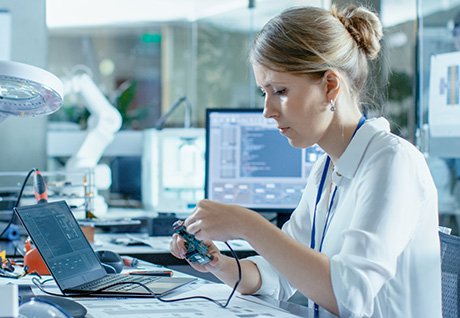
According to Eurostat, the European Union's statistics office, the number of women working as scientists and engineers in the EU has been on the rise. Data show an increase from 3.4 million in 2008 to 5.2 million in 2014, reaching 7.9 million in 2024.
Across all economic activities, women represented 40.5% of the scientists and engineers’ workforce in 2024. This share was higher in the total knowledge-intensive services (45.1%) and in the services (45.0%) categories. In manufacturing, women represented 22.4% of scientists and engineers, while in other activities, that share was 23.6%.
Among the EU countries, the proportion of female scientists and engineers varied widely in 2024, with the highest shares registered in Latvia (50.9%), Denmark (48.8%), Estonia (47.9%), Spain (47.6%), and Bulgaria and Ireland (both 47.3%). The lowest representation of female scientists and engineers was in Finland (30.7%), followed by Hungary (31.7%), Luxembourg (32.4%), Slovakia (33.6%) and Germany (34.6%).
At level 1 of the Nomenclature of Territorial Units for Statistics (NUTS 1), female scientists and engineers were in the majority in 11 EU regions:
- 4 regions of Spain: Canarias (58.8%), Centro (52.5%) and Noroeste (52.4%) and Sur (50.3%);
- 2 regions of Portugal: Região Autónoma dos Açores (57.3%) and Madeira (56.4%);
- Makroregion Centralny (54.8%) and Makroregion Wschodni (54.0%) in Poland, Severna i yugoiztochna in Bulgaria (53.3%), Norra Sverige in Sweden (52.0%) and Latvia (50.9%).
At the other end of the scale, the smallest proportion of female scientists and engineers was recorded in the Hungarian region of Közép-Magyarország (30.0%), the Finnish region of Manner-Suomi (30.7%), Sud in Italy (31.1%) and in the German regions of Rheinland-Pfalz (31.3%), Baden-Württemberg (31.7%) and Hessen (32.3%).
For more information: