07 May 2026
Science|Business: Make more use of Horizon Europe funding, Zaharieva tells university alliances
Science|Business article by Juliette Portala, 07 May 2026
Research commissioner’s remarks are meant to be encouraging, observers say, not stoke fears about future budgets
European Universities alliances should make more use of current Horizon Europe opportunities, research Commissioner Ekaterina Zaharieva has told MEPs, before any discussion of ringfenced funding in the next iteration of the programme.
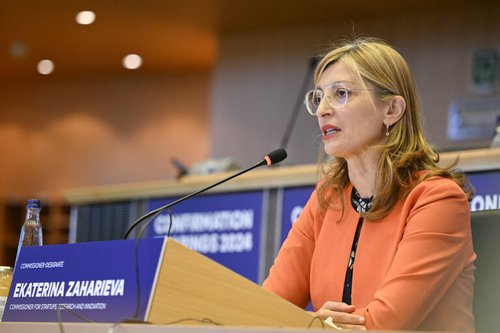
Responding to questions about future funding from the European Parliament’s culture and education committee on May 5, Zaharieva said that alliances were generally not bidding as such for funding already available to them in the current Horizon Europe programme. Instead, their members tend to form separate consortia to bid for EU research funds.
“We should really encourage them to use these organisations [. . .] to create easier consortia and to really participate and apply in Horizon Europe projects,” she said, adding that deeper collaboration would also reinforce the alliances’ education goals, for example by increasing trust and mutual acceptance of academic qualifications.
The European Universities alliances are international networks of higher education institutions, formed to develop joint curricula and stimulate student mobility across Europe. More than 570 institutions are currently involved in alliances, which are funded by the EU’s Erasmus+ education programme.
Last year, however, rumours circulated that funding for the alliances might be moved from Erasmus+ to the European Competitiveness Fund (ECF). This raised fears that funding would become conditional on addressing EU policy priorities, rather than the present arrangement in which alliances are free to set their own agendas.
So far, education Commissioner Roxana Mînzatu has not confirmed whether or not the European Universities alliances will receive funding from the next iteration of Erasmus+. In questioning Zarahieva, who is partly responsible for the ECF as well as Horizon Europe, MEPs were trying to come at the question from the other side.
Don’t panic
While her failure to commit to future funding for the alliances has alarmed some commentators, those closer to the issue are not overly concerned.
“I don’t believe this intervention is a signal of moving the core funding of the alliances, or even to reduce it,” said Kevin Guillaume, secretary general of the Circle U alliance.
For Mattias Björnmalm, secretary general of the Cesaer university association, Zaharieva is primarily encouraging the alliances “to evolve from being mainly education and mobility structures under Erasmus+ into stronger platforms also for research, innovation and knowledge valorisation activities where relevant, and to do that within the normal Horizon Europe logic of excellence-based open competition.”
The key point, he went on, is that Horizon Europe primarily funds excellent proposals through open competition, rather than allocating institutional funding to predefined groups. “In that sense, she appears to reject the idea of ringfenced Horizon Europe funding specifically reserved for European Universities alliances as such,” he said.
“[Zaharieva] rightly indicated that if alliance members also want to do research together, Horizon Europe is a perfect avenue for them to submit excellent proposals,” said Kurt Deketelaere, secretary general of the League of European Research Universities. “You would expect that they already would have done that much more if they are so eager to do research together. Seemingly that is not the case.”
According to Thomas Estermann, director for governance, funding and public policy development of the European University Association, this is only happening “to a limited extent” due to the fact that “scaling up such joint applications is not straightforward, as research collaboration needs to be built bottom-up over time.”
Björnmalm confirmed this analysis. “What seems new in [Zaharieva’s] remarks is a degree of frustration that relatively few alliances appear to be applying together in a structured way for Horizon Europe collaborative calls,” he said. “So, to me, her message can be summarised as something like: you already have a strategic advantage compared with many other consortia from having worked together deeply now for years, you should use it more systematically in the open and competitive calls.”
Besides, “making alliances depend on only one EU funding programme is certainly not the best way to secure their sustainability,” Guillaume said. “Therefore, I think it makes sense that the commissioner expects alliances to apply and get funding from other EU programmes.”
On that note, Zaharieva pointed to the importance of strengthening synergies between Horizon Europe and Erasmus+.
“We can combine the Marie Skłodowska-Curie Actions’ (MSCA) research training with Erasmus mobility,” she said. “Universities can use Erasmus+ mobility schemes to complement the MSCA doctoral and postdoctoral training, or MSCA researchers can also participate in short teaching, training or learning mobility periods abroad through Erasmus+.”
People and talent
The commissioner also made the case for boosting the European university ecosystem under the next Horizon Europe programme.
“Last week, I was in Silicon Valley and one thing was clear: stories of successful college drop-outs starting billion-dollar companies are not the full picture,” Zaharieva told MEPs, referring to her recent two-day trip to San Francisco. “Unicorn founders are six times more likely to hold a PhD and three times more likely to hold a master’s degree, which means that most of our European champions are created in university rooms and labs, not in garages.”
With this in mind, the European Commission closed in March a €20-million European Startup and Scaleup Hubs pilot action under Horizon Europe, which aims to “bring together the best of Europe’s science parks and accelerators rooted in strong university ecosystems, giving our start-ups access to infrastructure, knowledge and talent,” she said.
“The fiercest competition is about people and talent,” she went on. “Silicon Valley was created because of these two excellent universities that they have, which are boosting entrepreneurship, but also because they managed to attract the best and brightest people from all over the world. So, they were a magnet for those people.”
In this context, Zaharieva underlined the need to maintain links between universities and private companies, while continuing to invest in curiosity-driven basic research. “When governments or businesses request scientists to work together with them, it doesn’t mean that it’s interference in scientific freedom, because, actually, many scientists really want to contribute to society, and they also need this close relation with the private sector,” she said.
Ultimately, such collaborations unlock more money for universities and research organisations, and support the creation of start-ups.
Meanwhile, the Commission has continued work on retaining and attracting academic talent.
“Europe is on track to reach a 45% target for people with a university degree by 2030, but in academia, only one in 10 staff member is under 30, and four in 10 are over 50,” Zaharieva said. “The lack of new talent, as many approach retirement, is a risk for our competitiveness.”
She hopes that Commission plans to issue model employment contracts for scientists to boost their mobility and development can become “the gold standard for research careers.”
For 2025-27, funding for the Choose Europe for Science initiative has already grown from €500 million to nearly €900 million. “The results are already here,” Zaharieva said. “Non-EU applicants to our recent European Research Council call for advanced researchers have doubled, and our doctoral fellowships are receiving record levels of interest,” she added. “This is positive, but it shows the need for an ambitious future budget to keep up with demand.”
To read the original article on the Science|Business website, click here.