26 Feb 2026
Science|Business: Policy experts advise rethink of European Competitiveness Fund
Science|Business article by Martin Greenacre, 26 Feb 2026
Idea that ECF should steer research priorities is “misconceived,” Parliament hears, as the research community issues governance advice
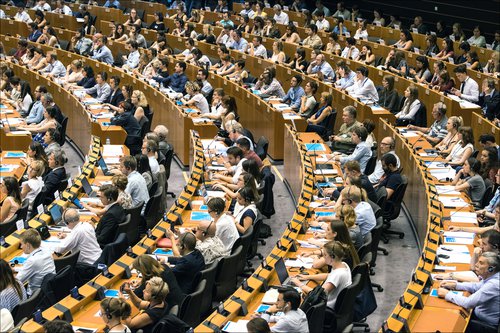
Johannes Jarlebring was one of several policy experts quizzed by MEPs. Photo credits: Alain Rolland / European Union
A rethink is needed to ensure the future European Competitiveness Fund (ECF) is effective and does not threaten the independence of the Horizon Europe research programme, experts told MEPs during a hearing on the ECF on February 25.
The European Commission had originally considered rolling the next iteration of the Horizon Europe research and innovation programme, also known as FP10, into the proposed ECF. In the end, however, it decided FP10 should be a standalone programme with close connections to the ECF, with the latter focused more on industrialisation and deployment.
“I think there’s still a lingering idea that the ECF should orient Horizon Europe, and I think that’s perhaps a little bit misconceived,” said Johannes Jarlebring, senior researcher in political science at the Swedish Institute for European Policy Studies, before the Parliament’s industry and research committee.
“I think it would be better to clarify the complementary roles of these two different funds, where Horizon Europe has a specific role to generate new knowledge and disruptive innovation, and where the ECF should be focused on deploying knowledge and innovation.”
While precise details on the links between the two programmes are currently missing from the draft legislation, the intended connection can be seen within Pillar 2 of Horizon Europe, dedicated to collaborative research, which will be structured around the same four priority areas, or policy windows, as the ECF.
The Commission is currently planning to have a single work programme for each policy window, with specific sections for calls funded by Horizon Europe and the ECF. For Jarlebring, however, it “could make sense” to have different work programmes.
The experts appearing before the committee also expressed concerns about the focus of the ECF. “I think the proposal we have right now is setting us up for failure,” said Fredrik Erixon, founding director of the European Centre for International Political Economy. “There are too many policy objectives, there are too many outcome objectives, there are too many sub-sectors and technologies that are being identified.”
Philippine Lévy, researcher at the IDDRI think tank’s New Industrial Policies programme, likewise pointed to the broad range of technologies included in the ECF. “We need to ask what we want this fund to do,” she said. “Do we want it to support existing industries that are competitive, or do we want to make sure that we identify where there’s a competitiveness gap?”
A common criticism of the ECF proposal is the lack of a definition for competitiveness, but the experts disagreed about what this should be. For Lévy, any definition should include autonomy, resilience and decarbonisation.
According to Jarlebring, increasing productivity should be the primary aim and autonomy should be the subject of “exceptional interventions.” This is because interventionist policies related to autonomy and national security are likely to create disagreements among EU member states and are therefore more difficult to implement, while they could also be addressed through other tools such as trade diversification.
One thing is certain: the ECF will not come close to filling the €800 billion annual investment gap that Mario Draghi identified in his report on competitiveness. As a result, its main role should be to promote risk-taking, as an “incubator for ideas” and for “generating new technologies,” said Laurian Lungu, co-founder of the think tank Consilium Policy Advisors Group.
For Erixon, the Commission is too focused on a macro view of industrial policy looking at investment gaps or comparing sectors with other countries, and is missing an “intervention logic” identifying the firms, sectors or regions where meaningful support could be provided. “It’s not about trying to plug an investment gap,” he said. “Try to drive as much innovation and as much change and disruption as possible.”
Too much flexibility
The Commission envisions the ECF as a flexible instrument that’s able to respond to new priorities. However, Jarlebring questioned how much flexibility the Commission can handle. “I see a considerable risk that too much flexibility will generate an ongoing haggling on priorities, and investments that can result from vague, untransparent political compromises,” he said.
The ECF represents “a huge shift compared to the current funds the ECF is supposed to consolidate,” he went on, as its policy windows are broad and “don’t pin down clear investment priorities.” There is also “a shortage of precise criteria and expert-based processes for deciding which projects will actually be funded,” and it gives the Commission a lot of discretion, for example to grant fund without open calls.
It will be challenging to define priorities on an ongoing basis under pressure from member states and specific industries looking to steer investments, Jarlebring said, since, as a union of states, the EU does not have a “strong political centre.”
“Give up a say”
During the question-and-answer session, Christian Ehler, the European People’s Party (EPP) co-rapporteur for the ECF and lead rapporteur for FP10, asked whether the proposed governance structures of both programmes are adequate to keep pace with the fast innovation cycles in sectors such as digital technologies.
He suggested moving towards a model inspired by the US Advanced Research Projects Agencies (ARPAs), which would mean the Commission and EU Council “have to give up a say on specific calls.”
“They would define the direction, they have an overriding right, but then we would go much more to an ARPA, industry, stakeholder-driven model,” Ehler said.
The design of the €409 billion ECF is dividing MEPs along not just political but also national lines. Within the EPP group, Finnish MEP Aura Salla said funding should be based solely on excellence without any geographical prioritisation, while Hungary’s Eszter Lakos is concerned a “winner-takes-all” policy would increase the innovation gap within Europe.
This question is also diving EU governments, and the experts, too, offered contrasting perspectives. According to Lungo, it is much better to have innovation spread across the EU rather than focused on two, three or four countries. Jarlebring, on the other hand, recommended not including geographical criteria in the ECF, suggesting support for capacity building is a better tool to close the innovation gap.
Research lobbies unite
The ongoing uncertainty around the ECF is a concern for the research community, which came together on February 25 to publish a joint statement setting out its vision for the ECF and its links to FP10. It follows another joint publication from December 2025 with proposed amendments to the FP10 proposal.
The latest statement says that the Commission’s proposal for the ECF risks “creating a de facto hierarchy in which FP10 becomes subordinate to short-term priorities,” and calls for “clear legal safeguards” to maintain FP10’s independence.
“The Commission’s proposal for the creation of the ECF leaves many aspects insufficiently defined, particularly regarding how the ‘tight’ connection with FP10 will function in practice, which legal safeguards can ensure that FP10 is not subordinated to the ECF, and how to avoid creating silos while ensuring effective coordination between the two instruments,” said Emmanuelle Gardan, director of the Coimbra group of universities.
Other organisations signing the statement included the Cesear university group, the European University Association, EU-Life, the Guild of European Research-Intensive Universities, the League of European Research Universities and the Young European Research Universities Network.
“We stand ready to work with the European Commission and co-legislators to make the FP10–ECF interface fully operational,” said Orla Feely, president of Cesear.
The research lobbies are also backing separate work programmes for FP10 and the ECF in each policy window. They suggest creating two strategic stakeholder boards, one for Pillar 2 in FP10 and one for the ECF, to include input from experts including researchers. The Commission’s ECF proposal includes a strategic stakeholder board to provide advice on the overall direction of the ECF and on “the identification of strategic portfolios of projects.”
The statement highlights the benefits of clear connections between the ECF and FP10, including through fast-track procedures so that results from FP10 can benefit from ECF instruments without starting from scratch. However, it notes that innovation does not follow a linear process, and says universities and research institutes should be able to contribute to both programmes.
Associated countries
The ECF should also be open to non-EU countries, including the UK and Switzerland, the research networks argue. “Association should entail participation on the same conditions as member states and consultation in work programme preparation,” they say. This should also apply to FP10.
In the current Horizon Europe programme, associated countries can participate in the committees that design work programmes, but do not get to vote in any contested decisions.
The recommendation is “not about a fundamental change to the governance or about giving associated countries the same formal decision-making role as member states,” but about ensuring appropriate consultation and predictability, and it could build on arrangements that already exist, said Kamila Kozirog, deputy director for research and innovation at the European University Association.
“If potential associated countries cannot know in advance where and under which conditions they will be able to participate until the work programmes are published, this uncertainty could reduce their willingness to associate,” she told Science|Business.
The research groups say that association processes for FP10 and ECF should be separate. “If association ends up requiring parallel negotiations across two programmes, that could risk creating additional complexity and potentially longer delays,” Kozirog said.
To read the original article on the Science|Business website, click here.