19 Oct 2026
Science|Business: Zaharieva defends Commission’s research budget proposal
Science|Business article by Florin Zubașcu and Juliette Portala, 15 Oct 2026
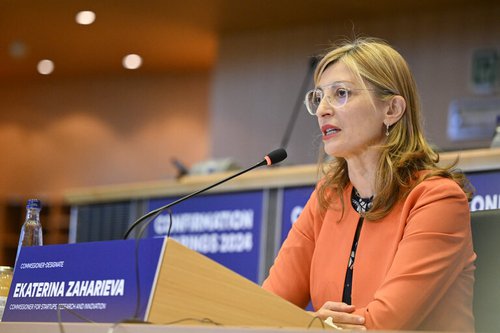
Cutting the EU budget for research and innovation would be “a strategic mistake,” EU research Commissioner Ekaterina Zaharieva told delegates at the international AI Summit in Dublin on October 14, just days after the Irish presidency of the Council floated a 9.6% cut to the €175 billion budget proposed by the Commission for the next Horizon Europe programme.
“In Horizon Europe [. . .] supporting all high-quality proposals today would need over an additional €150 billion,” she said. “So, I believe that cutting funds and resources for research and innovation, in particular Horizon for the next [multiannual financial framework], will be a strategic mistake.”
But, with governments still haggling over the size of the next EU budget, the European Commission fears the cuts could go deeper. “The first signs have not been encouraging,” Andreas Schwarz, head of Zaharieva’s office, told delegates to a conference organised by the Guild of European Research-Intensive Universities in Brussels on October 15.
“The negotiation box of the Irish presidency is already a gap of around 10%, and I fear it will be more,” he said. “My experience is that if further cuts are requested by the net payers, and they are, they will most likely come again from the non-allocated envelopes, like Horizon Europe or the [European] Competitiveness Fund.”
According to Zahariava, each billion euro cut in Horizon Europe would result in cutting 1,700 awardees, more than 300 SMEs and 500 companies, 600 universities and 2,600 researchers.
Maria Leptin, the president of the European Research Council (ERC), also pushed back against the proposed cut, telling a public event in Madrid that investing in science was “not a luxury.”
“I do understand the pressure on national policymakers to demonstrate immediate returns on public spending,” she said at an ERC Scientific Council meeting. “But we must ask whether we are actually making the right strategic choices for Europe right now.”
“The cuts proposed last Saturday by the Irish presidency for the budget of the next Horizon Europe Framework Programme [. . .] suggest that we’re not making the right choices,” she went on.
The proposed budget reduction for the programme is even higher than the 8% cut put on the table for the broader EU budget, which Leptin believes sends “the wrong signal” about Europe’s scientific ambitions. “Nobody seems to think that we need to put our money where our mouth is, and that’s why the proposed cuts to the budget for the next Framework Programme are so worrying,” she said. “It’s not too late to change course.”
In Brussels, research lobby groups are already preparing to address EU governments directly.
“As scientists, as research leaders, and as members of the scientific community, we have a responsibility to make the case to policymakers that investing in science is not a luxury,” Leptin said. “We’re not doing it as a luxury; what we’re doing is really a strategic necessity. If we want Europe to fend for itself, we simply must aim higher.”
“I hope that the voice of science, of universities, of researchers will be loud,” Schwarz said.
To read the original article on the Science|Business website, click here.